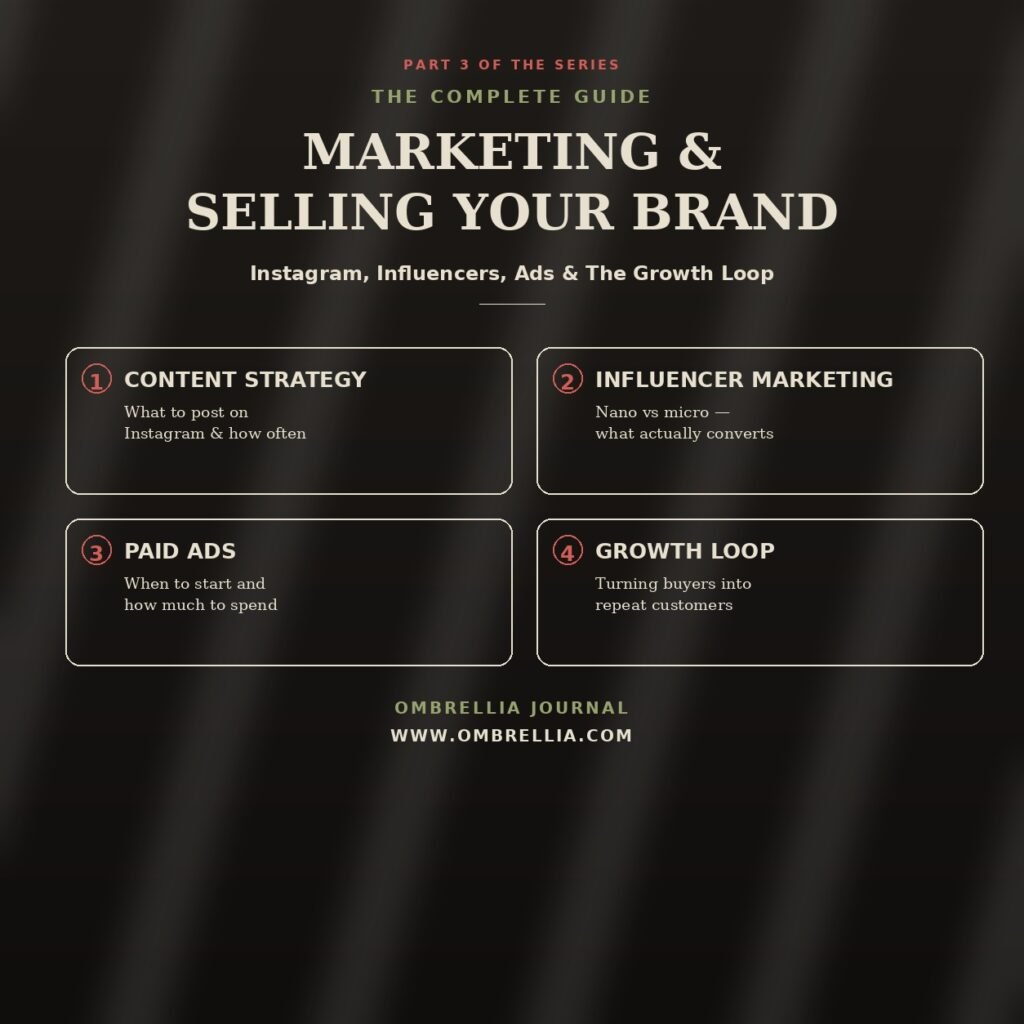
Clothing brand marketing is where most new founders get stuck after nailing the product…’
1. Clothing Brand Marketing Starts with Positioning — Decide This Before You Post Anything
Before any marketing, be able to answer in one sentence: “Why should someone buy from us instead of [bigger competitor]?”
Common positioning angles for streetwear/D2C clothing brands:
- Design-led: Distinctive graphics/prints you can’t find elsewhere
- Fabric/quality-led: Heavier GSM, better fit, premium feel at a fair price
- Story-led: Founder story, local manufacturing, a specific subculture
- Price-led: Best value for oversized streetwear in your category
Pick one primary angle — trying to be “premium AND cheapest AND most unique” confuses customers and weakens all three messages.
2. Instagram Is Your Primary Channel (For Most New Brands)
For a new clothing brand in India, Instagram Reels currently drive the most reach-to-cost ratio. A realistic content mix:
| Content Type | Purpose | Frequency |
|---|---|---|
| Product reels (like your drop videos) | Show the product in motion, build desire | 3-4x/week |
| Behind-the-scenes (manufacturing, printing, packing) | Build trust, show authenticity | 1-2x/week |
| Styling/outfit ideas | Help customers imagine wearing it | 2-3x/week |
| UGC/customer photos reposted | Social proof | As you get them |
| Founder-facing content (talking to camera) | Builds personal connection, converts well for small brands | 1x/week |
Posting consistency matters more than perfection — a rougher video posted 4x/week will usually outperform one polished video posted once a month.
3. Influencer Marketing — What Actually Works for Small Budgets
You don’t need big influencers to start:
| Tier | Followers | Typical Cost | Best For |
|---|---|---|---|
| Nano-influencers | 1K–10K | Often free product + small fee (₹500–₹2000) | Authentic reach, high engagement rate |
| Micro-influencers | 10K–50K | ₹2,000–₹15,000 per post | Good balance of reach and cost |
| Mid-tier | 50K–200K | ₹15,000–₹60,000+ | Once you have proven conversion data |
Approach for a new brand: send free product to 15-20 nano/micro creators whose aesthetic matches your brand, in exchange for one reel/post. Track which creators actually drive traffic (use unique discount codes per creator) before spending real money.
4. Paid Ads — When to Start and How Much
Don’t start paid ads until:
- You have at least 5-10 organic reels performing reasonably (helps you know what content converts)
- Your website/checkout flow is smooth (no point paying for traffic that can’t convert)
- You have basic tracking set up (Meta Pixel/conversion events, as covered in the Hotstar pixel setup — same logic applies to Meta/Google ads)
Starting budget approach:
- Test phase: ₹500-1000/day across 3-4 ad creatives for 5-7 days
- Kill underperforming ads early (low CTR, high cost-per-click) — don’t wait a full week hoping it improves
- Scale only the winning creative/audience combination
5. Your Website Is a Salesperson — Treat It Like One
Common conversion killers for new D2C clothing sites:
- Slow load time (test on mobile, most traffic is mobile)
- Unclear sizing information (add a detailed size chart + model’s height/size worn)
- No trust signals (no reviews, no clear return policy, no contact info)
- Too many clicks to checkout (aim for under 3 steps: product → cart → checkout)
- No urgency/social proof (stock counters, “X people viewing this” if genuinely true)
Add these to every product page:
- Multiple angle photos + at least one video/reel
- Fabric details (GSM, composition) — customers increasingly check this
- Size chart with real measurements, not just S/M/L
- Clear delivery timeline and return/exchange policy
6. Pricing Psychology for Launch
- Pre-book/early bird discounts (like your current “extra 10% off, first 30”) create urgency and validate demand before full inventory commitment
- Bundle pricing (2 tees for a discounted combined price) increases average order value
- Anchor pricing — showing a “MRP” struck through next to your selling price, if genuine, helps perceived value
Avoid discounting so often that customers learn to wait for sales — reserve real discounts for specific moments (launch, festive, end-of-season).
7. Email & WhatsApp — Underused but High-Converting
Most new brands ignore this and lose repeat customers as a result:
- Collect email/phone at checkout and via a website popup (offer 10% off first order in exchange)
- Send a welcome sequence (order confirmation → shipping update → “how do you like it” follow-up)
- Use WhatsApp broadcast lists for new drops — open rates are far higher than email in India
- Segment your list: don’t blast the same message to everyone — new visitors vs past buyers need different messages
8. Launch Week Checklist
- ☐ All product photography and videos ready and uploaded
- ☐ Pixel/tracking verified working (test order end-to-end)
- ☐ 5-7 days of content pre-scheduled around launch day
- ☐ Influencer/UGC content lined up to post launch week
- ☐ Email/WhatsApp announcement ready to send to any existing list
- ☐ Customer support plan (who answers DMs/comments during launch)
- ☐ Stock levels confirmed against expected launch demand
9. Post-Launch — What to Track Weekly
| Metric | Why It Matters |
|---|---|
| Website traffic source breakdown | Tells you which channel (organic, paid, influencer) is actually working |
| Add-to-cart rate | Low rate = product page or pricing issue |
| Checkout completion rate | Low rate = checkout friction or trust issue |
| Repeat purchase rate | The real indicator of brand health beyond first sale |
| Cost per acquisition (if running ads) | Compare against your margin to check profitability |
Don’t just track sales — track why sales are or aren’t happening. The metrics above tell you where to fix things.
10. The Real Growth Loop
New clothing brands that scale sustainably usually follow this loop:
- Post consistent content → builds awareness
- Convert awareness into first-time buyers via a smooth website + occasional paid boost
- Turn first-time buyers into repeat buyers via email/WhatsApp + genuinely good product experience
- Repeat buyers become organic promoters (UGC, referrals) → feeds back into step 1
Most brands that fail either skip step 3 entirely (all acquisition, no retention) or never get consistent with step 1. Marketing a clothing brand is less about one viral moment and more about showing up consistently until the loop starts compounding.