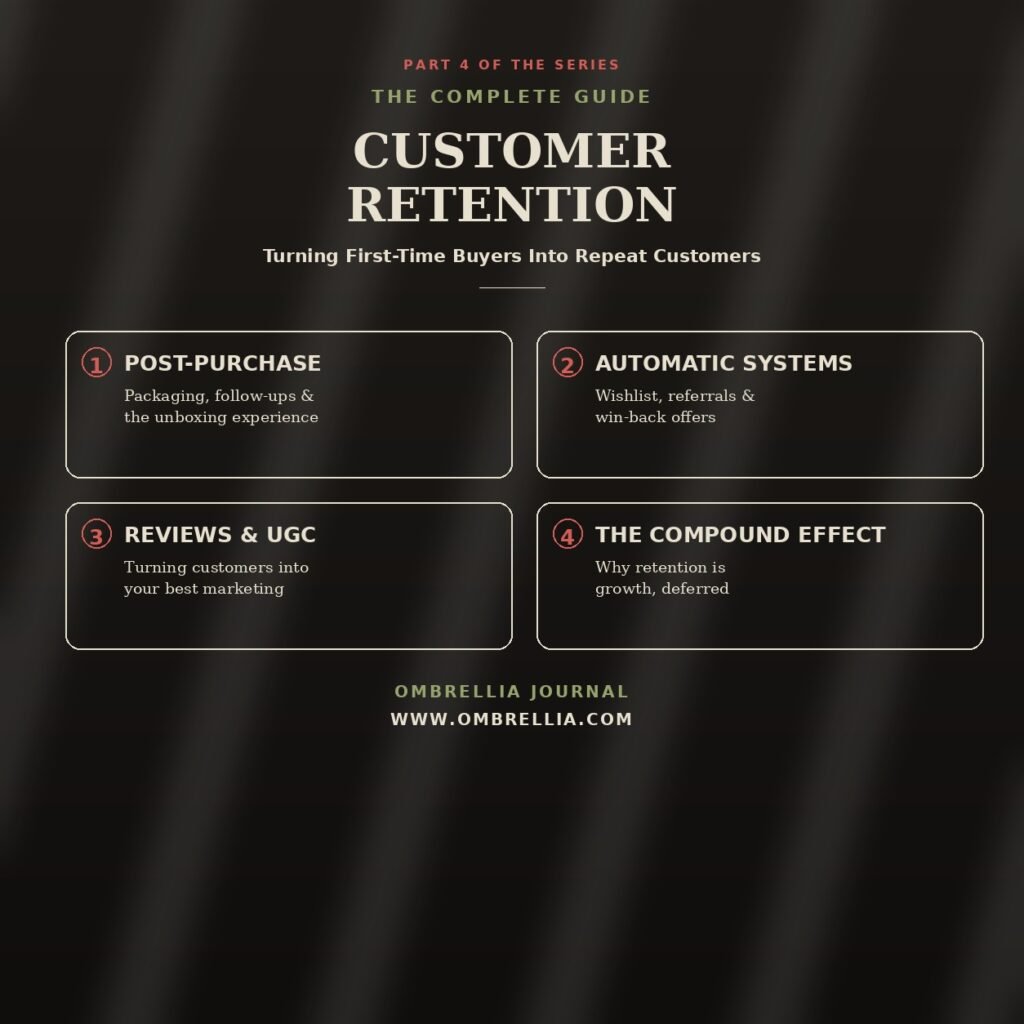
Customer retention is what separates a clothing brand that plateaus from one that scales sustainably. In Parts 1-3, we covered manufacturing, fabric quality, and marketing your clothing brand to get that crucial first sale. But here’s what most new founders don’t realize until it’s too late: acquiring a new customer costs 5-7x more than keeping an existing one. A clothing brand that only chases new buyers, without a plan to bring them back, is running on a treadmill — spending more and more on ads just to stay in place.
This part covers what actually keeps customers coming back.
1.Why Customer Retention Matters More Than You Think
Consider two brands with identical monthly ad spend and identical first-time conversion rates:
| Metric | Brand A (No Retention Focus) | Brand B (Retention Focus) |
|---|---|---|
| New customers/month | 100 | 100 |
| Repeat purchase rate | 8% | 35% |
| Orders/month (after 6 months) | ~108 | ~250+ |
| Revenue growth | Flat, ad-dependent | Compounding |
Brand B isn’t spending more on ads — it’s simply keeping more of the customers it already earned. That compounding effect is the real difference between a brand that plateaus and one that scales sustainably.
2. The Post-Purchase Experience Starts Retention Before the Product Even Arrives
Retention doesn’t start when someone buys a second time — it starts the moment they complete their first order.
Order confirmation & shipping updates:
- Send a warm, on-brand order confirmation email/WhatsApp message (not just WooCommerce’s default text)
- Proactive shipping updates reduce “where is my order” support tickets and build trust
Packaging & unboxing:
- A branded thank-you card, a small surprise (sticker, discount code for next order), or simply neat, considered packaging turns a transaction into an experience worth sharing on Instagram
- This is one of the highest ROI investments a small D2C brand can make — it costs a few rupees per order and generates organic content (customers posting unboxing videos/photos)
First-use follow-up:
- A simple “How’s the fit? Tag us @ombrellia” message 4-5 days after delivery re-engages the customer and surfaces any issues before they escalate into a negative review
3. Build the Systems That Bring Customers Back Automatically
Manual follow-ups don’t scale. The goal is to build (or use tools that build) repeat-purchase triggers that run without your daily involvement:
Wishlist
Letting customers save products they’re not ready to buy yet keeps intent alive. A customer who wishlists a hoodie in March is a warm lead in April when they’re ready to spend — without you paying for a fresh ad to re-acquire them. Pair this with an occasional “items in your wishlist are almost sold out” nudge for urgency.
Referral Programs
Your existing customers are your cheapest acquisition channel. A referral program (give the referrer a reward when their friend places a first order) does two things at once: brings in a new customer at near-zero cost, and gives the existing customer a reason to re-engage with your brand to check their referral status or claim their reward.
Exit-Intent & Win-Back Offers
Not every visitor buys on the first visit. A well-timed, non-intrusive offer (10% off first order) for visitors who are about to leave converts window-shoppers who’d otherwise disappear entirely. The same logic applies to past customers who haven’t ordered in 60-90 days — a small “we miss you” nudge often re-activates them cheaper than acquiring someone brand new.
Email & WhatsApp Segmentation
Not every customer should get the same message:
- New subscribers (haven’t purchased) → welcome series + first-order incentive
- One-time buyers → styling ideas, new drops, gentle nudge toward a second purchase
- Repeat customers → early access to new collections, loyalty recognition
- Lapsed customers (no purchase in 90+ days) → win-back offer
4. Reviews and UGC — Retention and Acquisition in One Move
Ask every customer for a review or photo 7-10 days post-delivery. This does double duty:
- For retention: the act of reviewing re-engages the customer with your brand and product
- For acquisition: genuine reviews and customer photos are one of the strongest trust signals for new visitors deciding whether to buy
A simple incentive (small discount code for a photo review) significantly increases participation without meaningfully hurting margin.
5. Handle Exchanges Well — It’s a Retention Moment, Not Just a Support Cost
How you handle a size exchange or a damaged-product claim directly shapes whether that customer buys again. A smooth, no-friction exchange process (clear policy, easy request submission, fast resolution) turns a potentially negative moment into proof that your brand stands behind its product. A frustrating, unclear, or slow process does the opposite — even if the customer’s item was eventually resolved fine, the experience of getting there is what they remember and tell others about.
6. What to Track Monthly
| Metric | What It Tells You |
|---|---|
| Repeat purchase rate | % of customers who order more than once — the core retention number |
| Time between first and second order | Shorter gaps usually mean stronger habit formation |
| Customer Lifetime Value (CLV) | Total revenue per customer over time — should rise as retention improves |
| Referral participation rate | % of customers who actually share their referral link |
| Wishlist-to-purchase conversion | % of wishlisted items eventually bought |
| Review/UGC submission rate | % of orders that generate a review or photo |
If repeat purchase rate isn’t moving month over month, that’s a signal to invest more in post-purchase experience and retention triggers — not just more top-of-funnel ad spend.
7. The Compounding Effect
Here’s the part that matters most: retention isn’t a separate activity from growth — it is growth, just deferred and compounded. Every customer who comes back is:
- Revenue you didn’t have to pay ad costs to earn again
- A potential referral source bringing in new customers at low cost
- A source of reviews/UGC that lowers your cost of convincing the next new customer
A clothing brand that nails retention early builds a flywheel: each cohort of customers contributes not just their own repeat purchases, but new customers through referrals and reviews — compounding in a way that pure paid acquisition never does on its own.
Getting the first sale is proof of product-market fit. Getting the second sale is proof of a business.